


Body Donation – A Gift to Medical Science
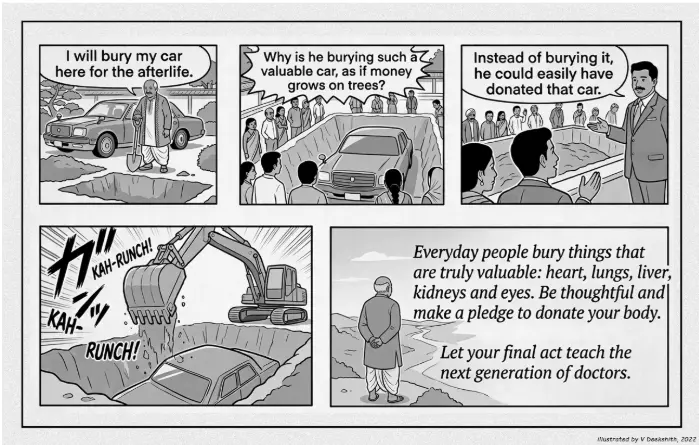
Human anatomy is the study of the human body, its structural components, and their functions. It is one of the core subjects in the MBBS curriculum and forms the foundation for the study of medical science.
Such donations are greatly needed, and this gift will be respected and valued by the medical community. The Department of Anatomy at the Kakatiya Medical College, Warangal, is dedicated to excellence in teaching and research, and the body donation program plays a vital role in this effort. We thank you very much for this kind thought.
We are grateful for the selfless and visionary act of body donation by Kaloji Narayana Rao garu and Kaloji Rameshwar Rao garu. Their choice reflects a profound commitment to society, showing that even after life, one can continue to contribute to the welfare of others. Their example has inspired many people to consider body donation as a noble and meaningful way to support science and humanity. We remember their generosity with deep respect and hope that their legacy encourages more individuals to take the pledge of body donation for the progress of medicine.
Frequently Asked Questions
The following are frequently asked questions that help clarify common doubts for donors and their families.
1. What is the importance of body donation?
Medical students and doctors need to study the normal human body to understand diseases and changes occurring in the body. This helps in proper medical and surgical treatment.
2. Who can donate their body?
Any person can donate their body, except those suffering from infectious diseases such as swine flu, COVID-19, hepatitis, HIV, etc. People with serious diseases like cancer and cirrhosis are generally not encouraged.
3. What are the prerequisites for body donation?
Only those who die a natural death (old age, heart attack, stroke, or non-infectious diseases) are eligible. Deaths due to suicide, homicide, or sudden unexplained causes (especially in young individuals) are not accepted, as they fall under police investigation. Severely burned bodies are also unsuitable.
4. What is the procedure for body donation?
The Principal, Kakatiya Medical College, Warangal on behalf of the Department of Anatomy, accepts donation of body after death for teaching and research purposes. The Will can be furnished on Rs. 10/- non-judicial stamp paper duly attested and signed by the Notary, as per the specimen supplied by the Principal, Kakatiya Medical College, Warangal. The Will duly completed by the donor and a self-attested copy of any identity proof should be returned to the office of the Professor & Head, Department of Anatomy, Kakatiya Medical College, Warangal for registration. A Xerox copy of Will may be retained by family members.
5. What is the protocol after death?
Relatives must obtain a death certificate from a registered doctor or hospital and inform the Department of Anatomy at Kakatiya Medical College, Warangal. Delay can make the body unusable. An official receipt of the dead body at Kakatiya Medical College, Warangal is issued by the Department of Anatomy on completion of the formalities. The body must be transported to the college by the donor’s representatives and handed over to the Department of Anatomy, Kakatiya Medical College, Warangal during working hours (9 AM to 4 PM). You can also contact NGOs that are working to facilitate this process.
6. Is the body used only for study purposes?
Yes, the body is used for teaching and training purposes. In rare cases, with approval, it may be shared with other medical colleges lacking such programs.
7. Is donor information shared?
No, information is kept confidential unless the body is received via NGOs or shared with another government institution.
8. How is the donated body used?
The body is preserved through embalming. It may be dissected, examined, and used for study over time. Tissues and fluids may be analyzed as part of educational and research processes.
9. What happens after use?
The remains of the body are respectfully interred in the designated burial area of the Department of Anatomy.
10. Are remains of the body returned to relatives ?
No. Due to the nature of educational use, remains or by-products cannot be returned, and no exceptions are made.
11. Can family refuse donation at the time of death?
Yes. Family members can decline donation at the time of death without giving a reason.
12. Can organs also be donated?
Organ donation is only possible in brain-dead patients on ventilator support. In natural death, only body donation is possible. Eye donation is possible in both cases.
13. How can a donor donate eyes?
Eye donation can be done through The Regional Eye Hospital Eye Bank or any nearby eye hospital before body donation.
14. Is there any fee?
No. The entire process is free of cost for the donor’s family.
15. Contact details
Contact the Principal office, Kakatiya Medical College, Warangal for any further enquiries.